Showing posts with label Jane Austen. Show all posts

Sunday, September 07, 2008

Lost In Austen Episode 1

Meet Amanda Price (Jemima Rooper), bored with her job, her boorish boyfriend and generally jaded with life. There's nothing she likes better than curling up with a good book (and half a pint of wine) and losing herself in the world of Jane Austen's Pride and Prejudice. Then one night after a drunken proposal from her boyfriend, Amanda while chewing on a piece of toast and possibly contemplating moving and not telling her boyfriend, hears a sound in her bathroom, arms herself with rolled up copy of Heat and discovers a night capped young woman pawing her underwear. It transpires that the young lady is Elizabeth Bennet (Gemma Arterton), who has travelled through a door from her house to Amanda's bathroom. Before much more can be discovered Amanda's boyfriend calls out which distracts her momentarily so when she looks back, Elizabeth is gone.
Amanda seems a little obsessed with Pride and Prejudice; in a visit to her Mum's (Pippa Hayward, who appears to have an problem with untidiness and paint pot samplers) she explains that it is the regency period that is so vividly described, the mores and manners, which beguile her. Her Mum sighs and gloomily states that Amanda's ideals probably won't be able to help her into her coat when she's seventy.

When Amanda gets home she discovers a transfixed Elizabeth in the bathroom turning on and off the mirror light. Amanda tries to explain that she is real and Elizabeth is fictional, but Elizabeth proves her that her "fleshly envelope" is as valid as Amanda's by telling her an obscure historical fact and then showing her the door into her world.
Amanda quickly hops through the door into Elizabeth's house, all wooden floors and lit by flickering candles and gasps in wonder at it. A door at the end of the corridor opens and a servant bustles through, Elizabeth smiles at Amanda as the door closes of it's own volition and Amanda is trapped on the other side as the door is closed and seeming fastened shut.
After frightening Mr. Claude Bennet (Hugh Bonneville) into dropping his books by hoving into view on the servants stairs, Amanda is ushered into his study and the story, that Amanda is Lizzie's long standing friend and that she is gone to visit Amanda in Hammersmith, is quickly concocted. Mr. Bennet after a very brief interview then exhorts Amanda to take Lizzie's bed for the night.
The following morning Amanda is woken by of Mrs. Bennet shrieking somewhere in the house and then is startled by the appearance of Lydia (Perdita Weeks) sharing her bed. Amanda gets somewhat overwrought about her situation and displays her "pubic topiary" to an astonished Lydia.

At breakfast Amanda 21st century attire is explained away as an otter hunting outfit which seems to satisfy the rest of the house. Mr. Bennet himself seems to acknowledge that Hammersmith is an "otter strewn thoroughfare".
Breakfast is interrupted by the arrival of Mr Bingley (Elliot Misen) who is being simpered at by Mrs. Bennet (Alex Kingston). All the Bennet girls, plus Amanda are ushered into to meet him, with apologies for Elizabeth's absence. Amanda is alarmed to notice that Bingley seems more enamoured with her than Jane (Morven Christie). Amanda then improvises a story about Lizzie wanting to write a book and travelling to Hammersmith to get the requisite peace and quiet to do so, much to the horror of Mrs. Bennet.

Amanda is loaned a few of Lizzie's dresses, for there are no otter to be hunted in the neighbourhood and Amanda encourages Jane by telling her that Bingley was very taken with her. Upon asking to brush her teeth, Jane points out the Birch twigs, chalk and salt to Amanda's consternation and leaves Amanda bemusedly holding the twigs and wishing she'd brought her toothbrush with her.
Bingley asks his sister Caroline (Christina Cole, who is the actress of choice when you want a bitch in a bustle) if she wants to go to church, Caroline declines and instead manages to get Bingley to stay at home to play cards with her, which he does reluctantly.
Amanda meanwhile traipses to church with the Bennet's and meets Charlotte Lucas who introduces herself shyly and then drops a clanger by mentioning that she speaks to Lady Ambrose, who just so happens to be a pig.
A ball has been arranged and the Bennet sisters and Amanda (who applies her extra bit of lucky lippy in the carriage much to the disapproval of Mrs. Bennet) are overwhelmed by the jollity. Amanda then spends much of her time availing herself of the punch and getting sarked at by Caroline Bingley.
Amanda despite her best efforts, gets asked to dance by the smitten Mr. Bingley and Amanda in a desperate effort to get the story back to its original course declines and says she's already engaged to dance with Mr. Darcy. Bingley calls over to Darcy, and at first a stout little red faced man appears to be about to totter over, when a tall, well dressed man revolves and takes all the puff out out of Miss Price with a single smoulder.
And doesn't he just he just look regency! He might have wandered in off the cover of a Mills and Boon. I don't like the wig though.

Darcy and Amanda begin to dance and Amanda quite reasonably doesn't know how to and doesn't so much dance as copy everyone else while remaining at least three beats out of time. She attempts vainly to engage Darcy in conversation, but he answers only peremptorily and doesn't disguise his dislike of her. At the end of dance he stalks off leaving an annoyed Amanda, who trudges outside for a crafty cigarette and then when Bingley turns up, plants a kiss on his surprised fizzog.

She then attempts to put right her impertinence by professing that she is a lesbian, leaving the reeling Mr. Bingley in an attractive state of confusion.

Mrs. Bennet corners Amanda at the ball and in no uncertain terms warns her not to scupper any of her daughters chances at matrimony. Alex Kingston who doesn't have much to do but shake her curls neurotically, obviously relished the chance to get her teeth into a scene and consequently Mrs. Bennet is one of the more interesting characters in the programme.
The following day Amanda encourages Jane to visit Bingley and dispatches her in the rain on a horse. Mary relates how Jane almost died of "the Grippe" last time she got a cold and panics Amanda into rushing headlong across country after her. This sets Mrs. Bennet into another flurry as she believes that Amanda is trying to usurp Jane in Bingley's affections and her finger-wagging remonstrations to Mr. Bennet are rebuffed in Mr. Bennet's inimitable way.
We end with bedraggled Amanda dragging herself through some bushes and aiming for Netherfield.
All in all, a fun twist on the story. It's evident that Amanda is an Elizabeth substitute and her astonishment at Darcy's rudeness at the ball a direct comparison to Elizabeth's first encounter with Darcy. Jemima Rooper is a thoroughly modern Amanda and Darcy, so far, is elegantly rude. Mr. Bingley it seems, is genetically mainly spanial and Mr. and Mrs. Bennet are utterly brilliant, as are Hugh Bonneville and Alex Kingston.

Gemma Arterton as Elizabeth is wasted in a minuscule role and though it would be fun to see Lizzie's adventures in modern day otter strewn Hammersmith, the show wisely remains in the Regency period and besides she's probably still in the bathroom playing with the light.

Monday, July 16, 2007

First Among Sequels

I ought to be writing the short play for my writing assignment, but I can't think of anything to write, or a theme, or any decent characters, or a plot that is anything other than half baked. So I've been reading instead. I should be writing, it's due in less that two weeks....

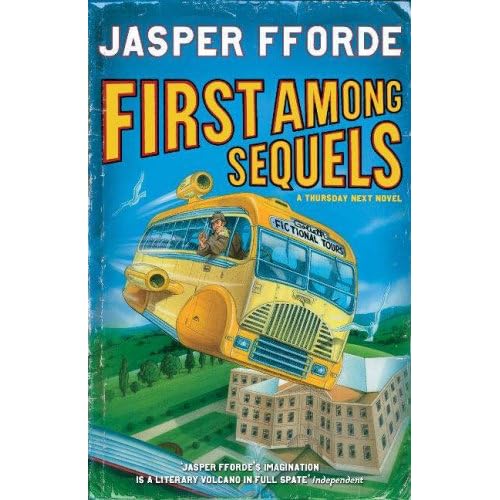
I've been reading the new Jasper Fforde, First Among Sequels, aka the further adventures of Thursday Next. In this book, Thursday is now a 52 year old mum, still gallivanting around the Bookworld and engaging in furtive SpecOps work, all the while trying to get her recalcitrant and supine son to join the Chronoguard. Add into this, illegal cheese smuggling, a devil in disguise, two fictional Thursdays, the ghost of Mycroft and the added burden of carpet laying and you've got an enjoyable story.

I won't spoiler the book as not everyone is trying to avoid doing work like I am and has already read it. There is no Rochester in this one, apart from a few fleeting mentions, but there is a little bit of Pride and Prejudice, but Fforde wisely doesn't introduce Darcy into the narrative. The Bennet sisters attempts at Mother control however raise quite a chuckle.

While the book is enjoyable, it's not as good as the previous books. There doesn't appear to be a solid central plot, in fact the book almost seems like it's made up of sub plots, some of which are criminally unresolved by the end of the book. Which is both good as there will be more Thursday, but also bad, because I'll now have to wait two years for the resolution. Dagnamit. And my footnoterphone dialogue is missing due to a printer's mishap. Grrggh.

A few highlights of the book were: the unfortunate piano mishap in Emma (there are apparently only 15 pianos in the whole of the Book World and only one elephant) and towards the end the way in which Fforde depicts the Big Nothing is really quite audacious and satisfying. That last sentence will have made no sense unless you've read the book, but it's is one of my highlights.

I missed Mrs. Bradshaw and Thursday's father in this book, and I really wanted Thursday to go booksploring for a way into Sherlock Holmes (because he died falling off Reichenbach Falls!) instead of her more moribund cadet training. Oh well.

If you've never read any Thursday Next novels, start at the beginning with the Eyre Affair (Jane Eyre get's kidnapped and plenty of Rochester) and work your way towards this one, take your time, you've got two years.

Now back to gazing at a blank screen wondering what to write....

Monday, April 30, 2007

Persuasion

Well, this post is better late than never, I suppose! Apologies for it's tardiness.

Persuasion starts with Anne Elliot, our main protagonist, rushing about her large stately house, making notes, which transpires to be an inventory of the household goods. Her house is to be rented out, as her vain and foppish father Sir Walter Elliot, played by the marvellous Anthony Head, had frittered it all away after his wife's death. That he is fond of spoiling his eldest daughter Elizabeth (Julia Davis) with strawberries and extravagant ringlets, has nothing to with being broke. Anne, who we have already guessed from her plain clothes and scraped back hair, in contrast to her flamboyant relatives, is the sensible one.

She pleads with her friend and confidante Lady Russell (the wonderfully nuanced Alice Krige) to stop her father and sister from being so free with their money and settle quietly in a rented house to save money. The house is to be rented to Admiral Croft and his wife, who as soon as they move in are taken aback at the number of mirrors, all belonging to Sir Walter, who is so vain, he carries a small mirror fastened at his wrist lest he go five minutes without seeing his own reflection.

As both father and elder daughter are set on glamorous Bath instead, Anne eventually waves them both off, in an ostentatious carriage and instead lodges with her sister Mary Musgrove (Amanda Hale), who is a hypochondriac bore. Mary professes ill health and then contradictorily proceeds to inhale the contents of the tea tray in one vast inward breath. Anne is saved from a fate worse than her sisters company all afternoon, by the arrival of her brother-in-law Charles Musgrove (Sam Hazeldine) and his cousins, Louisa and Henrietta Musgrove (played respectively by Jennifer Higham and Rosamund Stephen). Both of whom are willowy and pretty, but at the same time appear far plainer than Anne.
Both Anne and Mary are asked to tea up at the big house and when they get there are told that Captain Frederick Wentworth will be arriving soon. A successful and handsome naval officer who is the brother of Mrs. Croft, Anne's tenants. At this news Anne is upset, and Sally Hawkins, a fine and talented actress, displays all of Anne's dismay, repressed excitement and suppressed love in a scene not lacking in vast amount of tears and snot.


Wentworth (the incredibly gorgeous Rupert Penry-Jones) is Anne's lost love, he had proposed eight years ago, but was refused by Anne's family and Lady Russell as he was only a lowly naval officer then, but now after a short and successful career has returned, as a man of substance and means. And of course, in the words of Jane Austen herself, "a single man in possession of a good fortune must be in want of a wife", and so he becomes the neighbourhoods most eligible bachelor.

Anne it seems is fated to meet Captain Wentworth when asked to dinner, but a small child with a dislocated shoulder, which is popped back into it's socket by Anne herself, puts paid to that; however the child's parents both think they ought not disturb their own plans for the evening!

Eventually Wentworth comes to visit and catches sight of Anne, whereupon both he and Anne try to avoid each other as far as common courtesy and politeness will allow, but on a walk during which Louisa flirts outrageously with Wentworth and launches herself off a stile straight at his head, Anne manages to trump her and flings herself off a tree and into a river. She is rewarded with Wentworth tenderly gazing down at her bedraggled form as she comes round now that they've pumped all the water out of her lungs.

Anne and the Musgroves now decide to go to the seaside, but not for them sandy beaches, ice creams and deckchairs, no, they go on holiday, in what appears to be winter and stroll up and down the wettest, slipperiest and bleakest looking seafront in Britain.

I can only imagine that Wentworth's ulterior motive was to lure everybody to the end of the walkway, let them get washed off and carry Anne off on his horse. Alas this doesn't occur as Louisa Musgrove in a vain attempt to get Wentworth to notice her ability to fly, attempts her now patented stile vaulting routine, 10 feet in the air from the top of a flight of steps, onto concrete. Wentworth, ever the sensible fellow, realises that the weight of girl, corset, bonnet and ringlets from that height would squash him quite flat, moves imperceptibly out of the way, hoping that the girl's petticoats will act as a parachute and she'll glide safely down to him. Unfortunately Louisa decides to launch herself head first and manages to sustain a serious injury. Anne resists the temptation to throw herself in the ocean in an attempt to get attention and instead inspects the inside of Louisa's bonnet which appeared to be the only thing holding her brain in.


Wentworth, Anne and Henrietta travel back home to break the news of Louisa's accident to her parents and Wentworth and Anne exchange smouldering looks, while Captain Benwick and Captain Harville, friends of Wentworth, stay with Louisa, Mary and Charles.

While at the seaside a man later known to be William Elliot (Tobias Menzies), who it transpires is to inherit Sir Walter's estate after his death, is seen to observe the party and Anne in particular. More of him later.


Anne now travels back to Bath to rejoin her father and sister, who have been making the best of society and ingratiating themselves with distant relative, who has the distinction of being a Viscountess. They both practically prostrate themselves when she is in the room.

Anne of course is far too sensible and intelligent for such nonsense and she spends more time in the company of her friend Mrs. Smith (Maisie Dimbleby), who is not in the best of health. Her father takes great exception to these visits and berates her quite vituperatively.

While in Bath, William Elliot pays a visit to Sir Walter on the pretence that he wants to make amends for their previous falling out. Sir Walter labours under the impression that William wants to marry one of his daughters. William's actual aim is to prevent Sir Walter from marrying Mrs. Clay, Elizabeth's widowed companion. As Mrs. Clay is young and still capable of childbearing, he's afraid that a wedded union would strip him of his inheritance.

William makes himself agreeable to Anne and appears quite an honest and good man, the benefits of her marriage to him, especially at her advanced age would, mean that she would get to live back in her beloved house, but despite his kind and charming manner her obvious love for Wentworth, she finds her resolve being assailed by the persuasive remonstrations of her father and Lady Russell, and Anne feels that she could marry William and be tolerably happy.

Meanwhile back at the seaside, Wentworth and Benwick are walking in a field and discussing Wentworth's tangled love life. Wentworth knows that he doesn't want to marry Louisa, and Benwick, who was heartbroken when his first love died, tells him to seize the day, i.e Anne. Wentworth misunderstands and seizes a horse instead and rides away, but he rides in the direction of Bath, so all is not lost.
Once Wentworth reaches Bath, he hears that Anne and William Elliot are close, this disheartens him and he follows Anne around several Bath functions in a lovestruck manner, all the while trying to avoid Elizabeth's creative hairstyles and trying to get Anne alone with him.

Anne is being steered towards marrying William, and Wentworth fearing that he is too late, sends Anne a passionate love letter. Anne upon reading it finally realises that Wentworth still loves her as constantly and as passionately as she has loved him and waits for Wentworth to visit as he promises in his letter. At the appointed time, the door is knocked upon and instead of Wentworth, in walk the Musgroves.

Anne eventually tires of waiting and decides to go to find Wentworth herself, on the way she meets Mrs. Smith, who informs her that William Elliot is a scoundrel and a knave, he never wanted to marry Anne out of love, he just wanted to secure his inheritance and had managed to persuade Mrs. Clay to be his mistress. The scales fall from Anne's eyes and she decides to spurn Elliot and to run the length of Bath twice, (without her bonnet, the hussy) in an attempt to find Wentworth.

Eventually she gets tired and returns home to find Wentworth calmly standing on the doorstep talking to Charles about guns. Eventually Charles leaves them alone and love is professed, which ought to be sealed with a kiss, which takes about half a hour. Just kiss him love, you've waited eight years for this moment and now you just stand there. He's just as bad, she's short, she can't reach up that high, but he just stands there ramrod straight smirking down at her. Perhaps the kiss took so long she was just trying to catch her breath after running so far.


And what better way to end this film, but with a kiss.

Sally Hawkins and Rupert Penry-Jones were both marvellous, Sally demonstrated Anne's enormous wealth of feeling for Wentworth even after such a long separation and Rupert aptly implied all of Wentworth's pent up emotion and longing for Anne. The production was beautiful and the adaptation was faithful without being slavish. Adrian Shergold, the director, brought out the best in the cast and the locations and the drama was accented with slivers of humour and wit without resorting to the campiness that affected Mansfield Park. All in all, it was a fine end to the Jane Austen season.

Sunday, March 25, 2007

Northanger Abbey

After last weeks disappointing "Mansfield Park", I sat down to watch Northanger Abbey with not a little trepidation. Thankfully, I enjoyed it a lot more than the previous film, which is somewhat due to the fantastic writing of Andrew Davies (yes, he of "Pride and Prejudice" fame). He understands what is entertaining, and more importantly doesn't stifle Austen's innate, wry wit, a crime committed by Maggie Wadey in "Mansfield Park". The script stuck to the story with fidelity, with only few oddly stricken notes.


Felicity Jones played Catherine Morland, who was imbued with the wide eyed naivety required, who having been brought up on a diet of lurid novels, is quite ready for an adventure. As the mysterious voice-over told us, at which point my heart sank: not another blinking voice-over. Mercifully the voice-over only reappeared at the end and didn't impinge on the story at all.

Catherine's daydreams certainly put mine to shame, but then mine tend to revolve around confectionery, usually pastry based, and occasionally, violent acts of retribution towards my co workers. I also tend to steer clear of books of the ilk of "The Mysteries of Udolpho" and have a sneaking suspicion that I have led too sheltered a life. Catherine spends her reveries in fleeing saturnine and glowering men around dark, Gothic castle, complete with flowing locks and a floaty dress.

Catherine gets her chance at an adventure when Mr and Mrs Allen ask her to accompany the Bath as Mr Allen is somewhat gouty. Mr Allen (Desmond Barrit), though old and slightly infirm, shows himself to be quite a heroic person, as when Brigands attack the coach she and the Allen's are travelling in, he starts to fight them off with his crutch. Alas this all transpires to be one of Cathy's fantasies and Mr. Allen eventually reaches Bath with nary a hair out of place.

Bath was well created, with plenty of rampaging carriages, out of whose way the pedestrians must leap to safety as they barrel along at quite a lick. Anyway, once Mrs. Allen and Catherine have hit the shops for a new dress, or twelve, they make their entrance in the Assembly rooms, which are packed. Cathy and Mrs. Allen have to fight their way through the throng until they get to the tea room and have to race for the final two seats at the tea table. Which they have to quit, as there aren't any tea things and people are looking at them funny. The problem transpires that Mrs. Allen can't talk to anyone without first being introduced and as she doesn't know anyone, she can't just walk up and start chatting.

This impasse if only ended when Henry Tilney brushes past the ladies and apparently sticks Mrs. Allen with a pin. He transpires to be extremely knowledgeable about muslin, is complimentary toward both ladies and with a twitch of an eye manages to get two seats vacated for the ladies. To prevent any impropriety he then arranges an introduction from the Master of Ceremonies to allow conversation and the invitation of a dance with added devilish smirk, but only the one mind you, with Miss Morland.

JJ Feild was Henry Tilney and he is the other reason I found this film so satisfying; he's definitely easy on the eye, and portrayed Henry with charm, wit and intelligence. More importantly he can act and he looks good in britches. Though if I were him, I'd ask my agent to get me some modern dress work, I've seen him in three films: "Mrs. Beeton", "The Ruby in the Smoke" and now this. All good solid period drama, but very heavy on the tight trouser front.

I don't blame Catherine's subsequent fantasy of a devilish Henry interrupts her bath, which must have been incredibly draughty as it took place in wood. This is one of the scenes that I found slightly too modern, Catherine imagining Henry in her bath chamber was racy enough, but having her stand up in all her nakedness was just too much. Henry on the other hand looked entirely happy.

His sister Eleanor is played by Catherine Walker, and is the embodiment of sense, manners and kindness. She is the complete opposite to Carey Mulligan's dimpled, man-hungry, simpering Isabella Thorpe.

Her sweet face and demeanor mask a shallow and scheming soul, despite plighting her troth to the plain and good hearted James Morland, she then courts ruin by consorting, in a most un-Austen like way with lusty, chisel jawed Frederick Tilney (Mark Dymond). Scandalous.

Isabella is probably the most interesting character in the film, she's capable of sweetness, kindness and is friendly, but dig a little deeper and she's venal, greedy and scheming. Despite that, you can't help but to warm to her when, after she and Catherine have been spotted by two young and handsome men in a bookshop, they haughtily exit like duchesses, only to speed into a jog up an alley to catch up with them, so Isabella can flaunt her impressive decollete at them.

Several times I feared for that girl's bosoms, she was squeezed into frocks that were so low cut that nipple-skimming is an apt word.

As wolfish John Thorpe (William Beck) is sweet on Catherine and they are soon to be related by marriage, the Thorpe's make claims on her time and conspire to get Catherine to go on carriage rides by deception. The Tilney's have already made plans with Catherine, for a walk, but John insists that he saw them heading in the other direction on a different excursion and manages to get Catherine to come with them on a carriage ride.

If this were a modern day adaptation, John would drive a souped up Audi with tinted windows, bling hub-caps and the type of sound system, with bass so deep that it causes tectonic shifts. He drives so fast that Catherine needs two hands to keep her bonnet on and he doesn't stop, either, when he nearly runs over Mr. Allen, who angrily shakes his crutch at them, or when she spies the Tilney's walking along and wants to get off. His lame excuse is that he wanted to get to know her and that his sister couldn't possibly be left on her own with her brother, it wouldn't be proper.

Needless to say, with such an inauspicious start, the excursion does not end happily, they end up stuck behind a flock of recalcitrant sheep, in the pouring rain. William Beck makes an interesting and charismatic John Thorpe, but unfortunately has little to do and never for a moment does he pose a serious threat to Henry Tilney for Catherine's affections.

Catherine makes her peace with both Henry and Catherine at the opera and comes to the attention of their father, the stern and strict General Tilney (Liam Cunningham), who makes enquiries about her and is told by John Thorpe that she is an heiress, soon to inherit from the infirm Mr. Allen. With his interest piqued, the General asks Catherine to stay as Northanger Abbey, their home.

Catherine's imagination now goes into overdrive, imagining rugged men tying Isabella to a bed in a diaphanous nightie and being pursued by persons unknown through a dark and forbidding castle.

Once at the castle, after conversations with Eleanor, she becomes strangely convinced that General Tilney, murdered his wife and decides to investigate the nefarious actions of that forbidding man. She finds some papers one night in a chest in her room and when the light is extinguished by a gust of wind, scuttles quickly off to bed. The following morning, she finds that the papers are only laundry lists, but this doesn't deter her and she goes off to search for Mrs. Tilney's bedchamber.
One thing to note about Catherine's bedroom is the size of the wardrobe, it was so large that not only could it house all of Catherine's family (all ten children!), you could probably squeeze Narnia in there as well.

Meanwhile, back in Bath, while wearing a symbolic red feather, Isabella is deflowered by Frederick Tilney and piteously asks if they're engaged now. Doh! Haven't you seen the length of his sideburns love? Sideburns like these only grace the faces of dissolute, rakish reprobates. Next time take a ruler with you.

When Catherine is found snooping in Mrs. Tilneys dusty room by Henry, she confesses her theory and is castigated by him for entertaining such a stupid notion. That night she is woken by Eleanor and told that she has to leave immediately as they have a hitherto forgotten engagement. So poor Catherine, believing that Henry has told his father her assumptions, is sent away and is forced to share a coach with unwashed rustic types, who offer her what looks to be raw tongue as a repast, which she declines politely and one man who travels with a pot of liquor in one hand and live goose in the other.

Once home, Catherine burns her copy of "The Mysteries of Udolpho" as she has realised that life is not a Gothic fantasy and gets on with teaching her adorable little brothers how to read.

Soon after, Henry comes to call to apologise and after politely drinking the proffered lemonade, he asks Catherine to accompany him to see the Allen's. An annoying sister pipes up that you can see the house from here, evidently believing Henry to be a dunce, but Mrs. Morland shushes her and practically shoves Catherine out of the door with him.

Of course this is a costume drama, so a proposal is now offered and accepted and all is happy ever after. Apart from Isabella who desperately tried to get James back via Catherine, and General Tilney, who is estranged from Henry and apparently now spends most of his time grumpily striding through grounds of his estate alone.

All in all, a fabulous adaptation, not a classic, but a distinct improvement on "Mansfield Park" and it was witty, funny and enjoyable. With fantastic performances from all concerned, who said their lines believably, lush locations and many women with feathers in their hair (there must be some mighty cold ostriches somewhere), I thoroughly enjoyed it. And especially, kudos should go to Andrew Davies, whose script was funny, raunchy and very, very good!

An interview with Andrew Davies can be found here.

Northanger Abbey RadioTimes Article

From the wonderful Austenblog (courtesy of Janeite Kathleen) comes a scan of the Northanger Abbey article in the RadioTimes.


Let's see if this JA adaptation is better than the last...

Monday, March 19, 2007

Mansfield Park

I like Jane Austen, I loved "Pride and Prejudice" (with added wet Colin Firth, who didn't?), I loved the film version of "Sense and Sensibility" and I love the books with out question. So when ITV announced an series of Austen adaptations I was excited, but also a bit nervous, because the BBC do costume dramas a lot better than ITV. But I sat down, to watch Mansfield Park with a large cup of tea and big hopes.


The cast was youthful, with two very recognisable faces in prominent roles: Billie Piper as Fanny Price and Michelle Ryan as Maria Bertram. In addition to whom, Hayley Atwell played the scheming Mary Crawford and Catherine Steadman played Julia Bertram.

The boys in breeches were: Rory Kinnear as Mr. Rushworth, Blake Ritson as Edmund Bertram, Joseph Beattie as Henry Crawford and the delicious but sadly little used James D'Arcy as Tom Bertram. Adding some age and gravitas to the cast were Maggie O'Neill as Aunt Norris, Jemma Redgrave as Lady Bertram and Douglas Hodge as Sir Thomas Bertram, who were both far too young to be the parents of such aged children, did they start popping the sprogs out when they were 12?


Mansfield Park is the story of Fanny Price, a poor relative taken to live with her rich Aunt and Uncle as their home and is brought up alongside her cousins Maria, Julia, Tom and Edmund. Out of all her cousins only kind Edmund takes any notice of her and is kind to her. We are told this in Fanny's voiceover, which is never a good sign. I'm not a fan of voiceovers. As I'm familiar with the novel, I tend to find them patronising. In this case it was used as exposition, but it did feel a bit clunky.

After beginning with the brief introduction of young Fanny at Mansfield Park, the story speeds forward to a now grown up Fanny Price and her cousins. Maria is a vain woman, engaged to be married to Mr. Rushworth, who is a silly man and infatuated with Maria. Julia her sister is Maria's twin in all but years and Tom is a layabout, drunk and gambler. Only Edmund is steadfast and good, and is just about to be ordained as a clergyman.

While Sir Thomas is away on business in the West Indies, trouble comes to call in the shape of brother and sister Henry and Mary Crawford, a handsome pair of siblings, with flowing locks on one side and the obligatory period drama bosoms on the other.

You know they are going be bad news, his cravat is unnecessarily flouncy and she wears very fancy hats. Their plan is to marry Henry off to Julia, while Mary sets her sights on Tom. Things do not go to plan, Henry catches the eye of the already engaged Maria and Mary has to make do with Edmund as Tom is out carousing and betting on horses. Both Henry and Mary are shallow but calculating characters and they are portrayed very well by the actors. Unfortunately neither of them is entirely capable of speaking in regency grammar and sounding authentic. Almost all the characters are unable to make the period dialogue sound convincing and realistic and it shows.

The Crawfords convince the Bertrams to put on a play, how racy! Which eventually comes to nothing as Sir Thomas returns from the West Indies and shows his disapproval by glowering and burning the scripts, by which time Mary has beguiled Edmund, to the disapproval and disappointment of Fanny.

Maria foolishly marries Mr. Rushworth, who was brilliantly brought to life by Rory Kinnear (an actor who I think will go far) as a vain, foppish and silly man. Sir Thomas in a fit of insight, plainly asks Maria if she is happy to marry Rushworth, as he has noticed her attraction to Henry. Maria replies that she is very happy to marry Mr. Rushworth and so they are married and Maria leaves the family home for her own in London.

Now Henry deprived of Maria and the younger Julia turns his attentions to Fanny, he seems quite taken with her sweetness and in his pursuit of her affections arranges to get her sailor brother William a commission on a ship.

Unfortunately when Henry comes to propose, Fanny turns him down, she only has eyes for Edmund; this makes her Aunt and Uncle unhappy. Aware that Fanny is poor and therefore not particularly marriageable, they are horrified that she refused. As punishment they leave poor Fanny all alone in the house while they go to visit Lady Bertram's sister. This made me quite angry, the writer deviated from the book considerably by entirely writing out the rest of Fanny's family, whom she goes to visit (in the book) instead of rattling around a house on her own. Regardless of that deviation, this treatment of course has no effect as, Mr Crawford is again rebuffed when he comes to call.

By this point Edmund is a certified clergyman and Mary Crawford is pleading with him to take up law instead to of the church, despite her attraction to Edmund she doesn't want to even dance with a clergyman, let alone marry one.

When Sir Thomas and Lady Bertram return home, they bring Tom back with them. He is gravely ill, as his drinking and carousing have left him very ill. But you'll be glad to know after the icky application of leeches (ew) and bed rest, with Fanny reading the Racing Post to him, he's soon better. Edmund is also home to check on his brother, and this is when the news reaches them that Mr Crawford, reeling after Fanny's cruel rejection, retreated to London where he visited Maria Rushworth and was comforted by her ample bosom. Scandalous. Of course Aunt Norris avers that it's all Fanny's fault, if she hadn't refused Mr Crawford, Maria would never have been in that situation.

Mary Crawford, trying to salvage something from the now extremely awkward situation, tries to get Edmund to intervene and get Henry and Maria married, so that the path to Edmund and her own nuptials be smoothed. Edmund finally sees Mary for the scheming gold digger she is and sends her packing.

Edmund eventually sees that Fanny is the girl for him, in the most hammy acting I've ever seen. The realisation that he loves Fanny dawns over his face in a second and he practically does a double take of Fanny. He may as well have stood up and said: "Why Miss. Price, you're beautiful!" Before you know it, they're married and are waltzing on the lawn.

The problem with the film was not the cast, they were uniformly good, with extra kudos, from me at least, going to Jemma Redgrave and Douglas Hodge playing the indolent Lady Bertram and the slightly tyrannical Sir Thomas respectively. They were such an engaging couple that I wanted the story to focus more on them than on the younger cast. This is never a good thing especially when they aren't the main focus of the story.


Setting aside the changes made to the story, the cast were good, who were unfortunately not entirely able to carry off the period dialogue realistically and this was a big problem. I didn't see them as the characters and Billie as Fanny Price was sweet, toothsome and winsome, but that just wasn't enough. The writer Maggie Wadey managed to take the story and iron nearly every piece of wit and humour out of it. Aunt Norris should've been a figure of ridicule and humour, instead when she finally leaves to live with Maria, you're glad to see that back of the old bat!

It's impossible not to measure this production up against the juggernaut that was "Pride and Prejudice", which just isn't fair, on it's own merits it was perfectly fine, but compare it and the lack of humour, uneven script and a relatively young cast, mean that it although it was enjoyable, it's not going to go down as a classic. Despite this, when Fanny and Edmund dance on the lawn at their wedding, I had a huge grin on my face, what can I say, I'm a sucker for a happy ending.


Jane Austen Article Scans

It's been a long time since I've posted, sorry, that's just down to complete laziness ( and the worst sore throat ever!), I promised some Jane Eyre DVD snark, but it's been so long since I watched the extras, I've forgotten what I wanted to write. Which means that I'll have to watch them again! Oh the hardship...

Any way, while I rewatch, I bring you another Jane: Jane Austen that is. ITV have just started their Jane Austen season, which include films of Mansfield Park, Northanger Abbey and Persuasion. I've scanned in the Radio Times articles for your perusal. Click to make them big!
The lovely leading ladies.

Page one.

Page two.


Billie Piper blurbette and finally (below) the preview.


And if that's not enough Jane Austen for you, please check out ITV's flash tastic Jane Austen website and the RadioTime's interviews with the three leading ladies, in which Billie very candidly describes the hardship of peeing in costume...